
DataDelivers Perspective
Driving Traffic Beyond Loyalty
The National Restaurant Association's latest traffic data says what your P&L already suspects: guest counts have been sliding while higher checks covered the gap. Here's what the data shows, what's underneath it, and the playbook for winning those guests back.
At a glance
- The slide is broad and measured. More operators have reported losing traffic than gaining it in 16 of the last 17 months (National Restaurant Association), and one good month is not a trend.
- Checks are masking falling guest counts. Sales holding flat while visits fall means fewer guests, paying more: a base that's shrinking, not stabilizing.
- Guests choose from a shortlist, not a search. Our read: a flood of options means the decision runs on memory. Brands aren't being rejected, they're being forgotten. Loyalty only helps you see a small portion of your total guest behavior.
- Reach changes the math. Guests reached one-to-one come back at 2.7× the rate of everyone else (2026 Restaurant Guest Engagement Report), and the playbook below is how brands put that to work.
What the Traffic Data Actually Says
Start with the broadest read available. In the National Restaurant Association's monthly operator survey, more restaurants have reported falling year-over-year traffic than rising traffic in 16 of the last 17 months, while over the same stretch most operators kept reporting same-store sales that held or grew. Sales up, traffic down, month after month: the line is being held up by the check, not the guest count.
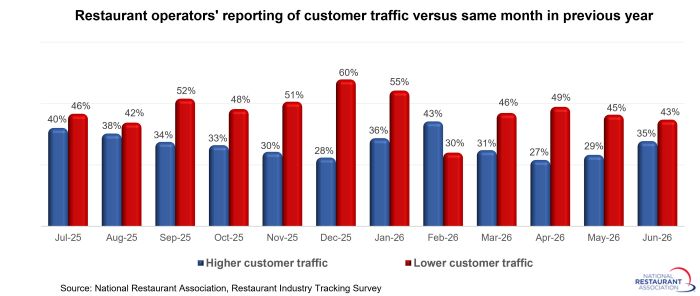
| Month | Higher traffic | Lower traffic |
|---|---|---|
| Jul 2025 | 40 | 46 |
| Aug 2025 | 38 | 42 |
| Sep 2025 | 34 | 52 |
| Oct 2025 | 33 | 48 |
| Nov 2025 | 30 | 51 |
| Dec 2025 | 28 | 60 |
| Jan 2026 | 36 | 55 |
| Feb 2026 | 43 | 30 |
| Mar 2026 | 31 | 46 |
| Apr 2026 | 27 | 49 |
| May 2026 | 29 | 45 |
| Jun 2026 | 35 | 43 |
Transaction-level trackers show the same mechanism. Revenue Management Solutions' data, as reported by QSR Magazine, had visits down 2.9% year over year against a 3.8% rise in average check late last year, and Black Box Intelligence's panel has logged month after month of negative traffic growth into 2026, with check growth propping up the sales line. Guests are spending more per visit and visiting less often. One good month doesn't change it: February's gain came and went. A brand that finally posts growth after a long slide hasn't reversed the trend, it's had a good month.
What We See in the Guest Data
Our own research shows the same slide from the inside, at the guest level, where industry data can't see. The 2026 Restaurant Guest Engagement Report analyzes credit-card transaction behavior across thousands of restaurant locations, and this year's picture is the traffic story told guest by guest. Brands entered 2026 with 73% of their former customers inactive: guests who used to visit and hadn't transacted in the prior year. New guests aren't arriving fast enough to cover the losses. The pressure operators report is real, and it is individual guests, one by one, quietly dropping out of the base.
The report's methodology carries one more finding worth sitting with: loyalty data often overstates guest engagement. The program's view of the guest base reads healthier than the base actually is, which is exactly how a brand loses traffic for a year while believing it has the situation covered.
The economics run one direction. Acquisition-led growth means paying full freight to replace guests who quietly walked, when keeping a guest, particularly with regular email, costs roughly a tenth of winning a new one. Focusing only on acquisition is the most expensive strategy on the menu.
From the 2026 Restaurant Guest Engagement Report
The 2026 Restaurant Guest Engagement Report: 113 million transactions, 77 million guests, 3,200+ locations.
Industry benchmark
The Problem Under the Problem
Here's our read of what's actually happening, because "consumers are pulling back" doesn't explain the data. Guests are still dining out. They're running sharper math on every occasion: is it worth leaving the house, worth the wait, is what I'm getting worth what I'm paying? Guests aren't rejecting price. They're rejecting the gap between what they paid and what they expected.
Before that math even runs, there's a shorter test. Search doesn't decide the occasion. A guest who looks up nearby restaurants gets flooded with options: a single location typically shares its trade area with more restaurants than anyone could hold in their head. A brand relying on the search moment is hoping to get picked out of a crowd that size. The where-are-we-eating decision runs on memory instead: a mental shortlist of a few names that fit the moment. Being on that list is the precondition for winning the occasion.
From the DataDelivers team
“If you are not in that mental consideration set during that conversation, the likelihood of us visiting you for dinner is pretty low. None of us are searching ‘restaurants near me’ when we have that conversation with our spouse; we go through the places we know. But you have to be on that list to even have a shot.”
Pat Riley · VP of Sales, DataDelivers
Which reframes what a traffic strategy has to do. Staying on the shortlist is a memory game, and memory needs contact. Being top of mind when the decision runs means staying in front of guests continuously, across the whole base, not a slice of it. That's where most brands are structurally stuck: the majority of their guests are anonymous. Real visits, real spend, no name, no permissioned channel, no way to stay in front of them at all. For those guests, falling off the shortlist isn't a risk. It's the default.
| Group | Share of guests |
|---|---|
| In the loyalty program: named, opted in, reachable | about 20% |
| Everyone else who walked in: no name, no channel | the other 80% |
It's tempting to look at the loyalty program and feel covered here. The sends go out, the offers redeem, the dashboard says engaged. Loyalty is worth every bit of that attention: the guests who raised their hands are your most valuable relationships. But the loyalty program's view and the overall customer base are not the same thing, and the guests deciding your traffic line are mostly people who haven't signed up for loyalty. They didn't unsubscribe. They didn't complain. You just can't see that they stopped appearing, because your loyalty program can't see them. However hard you work your loyalty list, it's finite, it skews toward your best guests, and no send frequency makes it bigger. You can't make up for lost revenue outside of loyalty with loyalty alone.
From a DataDelivers customer
“There's only so many times you can email people, and email gets a little bit diluted. We still need to reach our guests outside of just the loyalty platform, and not just our most engaged guests. We want to reach the people that are coming into Firebirds but aren't in tune with our Inner Circle club.”
That's the problem under the problem. Forgotten, not rejected, and invisible while it happened.
The Playbook: Winning the Guest Back
If the diagnosis is that your restaurant has dropped off the shortlist in your guest's mind, the strategy is presence: being reachable and relevant before that decision runs. The highest-value place to apply it is the audience most brands write off, the guests who already know you and stopped coming in. Four moves, in order.
The playbook
Guests reached one-to-one come back at 2.7 times the rate of everyone else. Source: the 2026 Restaurant Guest Engagement Report
Measure traffic in guests, not dollars.
Separate check growth from guest counts in your own reporting, and track how many of last year's guests came back this year. A flat sales line can hide a shrinking base for a long time. The industry data above is what that looks like at scale.
Make the anonymous majority reachable.
At most brands, the majority of guests are anonymous: real visits, no name, no channel, no permission to reach them. This is what Guest Connect was built for, working out who those guests are from how they pay and reaching the matchable portion through channels they've already agreed to receive. That audience already knows you. It just doesn't hear from you.
Go always-on; let creative follow the season.
Presence can't be a burst. Routines get rebuilt at moments like back-to-school, when the where-are-we-eating decision gets made fresh. The brands present while the routine forms are the ones written into it. Run the program continuously and let the creative meet the season.
Measure against business as usual.
Whatever you run, and whoever you run it with, measure it against a holdout: a slice of guests deliberately left alone, business running as it would have anyway, outside the marketing program. That's how you know the visits were created, not merely counted. If a program can't show its results that way, ask why.
How Kahala Brands thinks about the guests who stopped coming in
“To me, it's mostly been about grabbing those people who haven't been in. Retention rates are bad for almost every restaurant, so taking that large group of inactive people and getting some of them to visit again throughout the year is a really important segment. Even if you're discounting that visit, you're still getting a sale where otherwise you probably wouldn't have.”
 Brandon Hodgins · Director of Loyalty Marketing, Kahala Brands
Kahala Brands built its retention program around those guests. Read the full Kahala Brands case study.
That lift is measured, not hoped for. What decides how much traffic it drives is how many of your guests it can reach at all, which is exactly what move two changes. Turning anonymous transactions into marketable guests you're allowed to reach is the job of a restaurant customer data platform (CDP), and every guest you can market to improves the likelihood of keeping them active with your brand.
Your Next Marketing Audience Is Already in Your Transaction Data
If traffic is the pressure and the loyalty list is tapped, the guests you can't market to are the most direct place to look. We'll show you what that audience looks like at your brand, and what winning it back is worth.