
Insights from 77 million guests across 3,200+ restaurant locations reveal how brands that used 1:1 marketing retained 2.7x more guests than those that did not.
For three consecutive years, restaurant brands have lost active guests at rates that loyalty programs alone cannot offset. What began as a post-pandemic disruption has solidified into a structural problem: each year fewer guests are returning resulting in a shrinking engaged customer base.
Each year of continued guest loss concentrates revenue among fewer customers. As acquisition costs rise and visit frequency remains constrained, the pressure on operators continues to build. 2025 marks the third consecutive year that operators began the year with fewer active customers than the year before.
The data is clear: brands that invest in identifying and engaging guests directly retain 2.7x more guests than those who do not. Retention must shift from a marketing KPI into a core business strategy across all functional areas for brands who want to reverse the trend of declining traffic.

Consumer research from McKinsey shows diners are increasingly prioritizing value and reducing discretionary restaurant visits, reinforcing why retaining existing guests has become a critical business challenge for restaurant brands.
Source: McKinsey & Company, “What U.S. Consumers Want From Restaurants in 2026.”
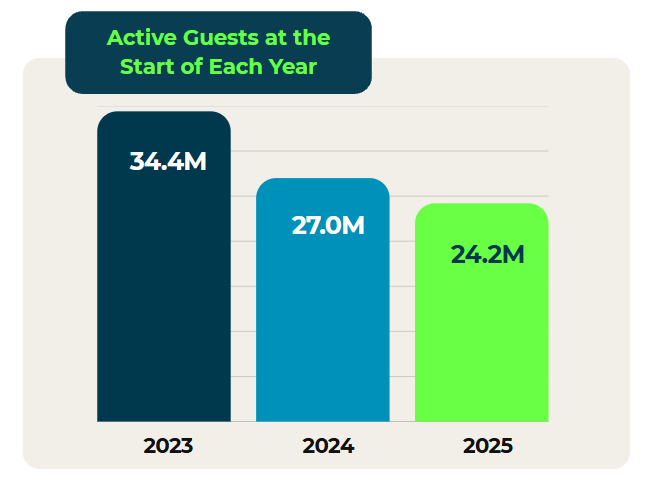
Restaurants are starting each year with fewer active guests. For three consecutive years, the total number of active guests at the beginning of the year has declined.
As the active customer base gets smaller, every guest becomes more important. Keeping guests engaged is critical to hitting revenue goals, and replacing those who have churned adds costs to budgets already under pressure.
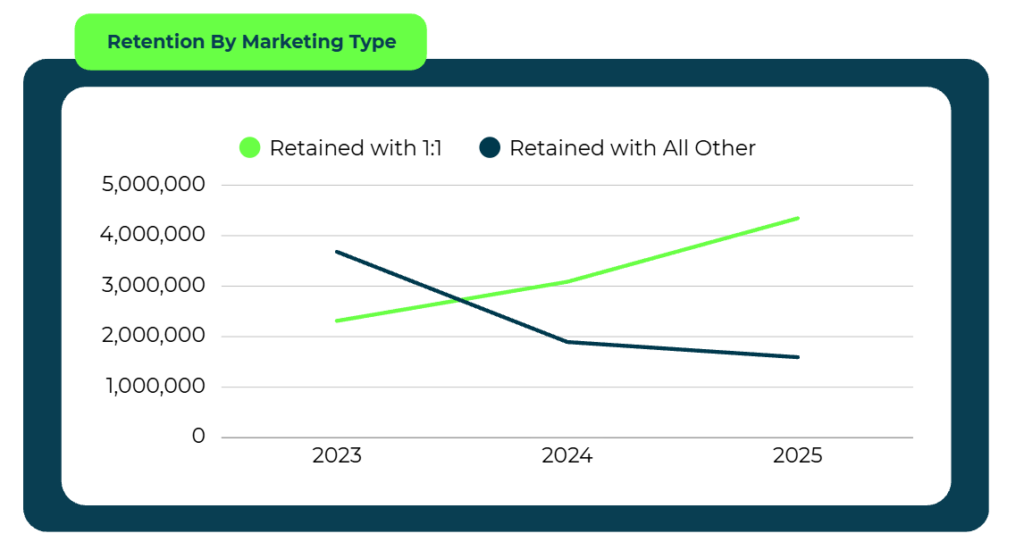
In 2025, retained and re-engaged guests accounted for 48% of trackable sales and generated over $400 million across the analyzed portfolio. This performance is driven by a clear marketing strategy: guests receiving 1:1 marketing delivered measurably higher results across every metric.
During 2025, 35% of guests receiving direct marketing messages remained engaged with the brand, compared to only 14% of those getting non-targeted broad marketing; a 2.7x increase! Over the past three years, operators have seen a continuing decline in the number of engaged guests who can’t be directly targeted. Yet the number of engaged guests getting 1:1 messaging has increased YoY and has become more frequent and more valuable as a whole.
Many brands operate loyalty programs that contain highly valuable guests that can be reached through 1:1 marketing. This keeps guests engaged at higher rates. However, participation in loyalty programs tops out at around 15%-20% of the customer base, leaving many customers unknown and unreachable. Getting marketing to the “other 80%” is critical to improving retention and reducing churn beyond the impact you can get from loyalty alone.
What This Means:
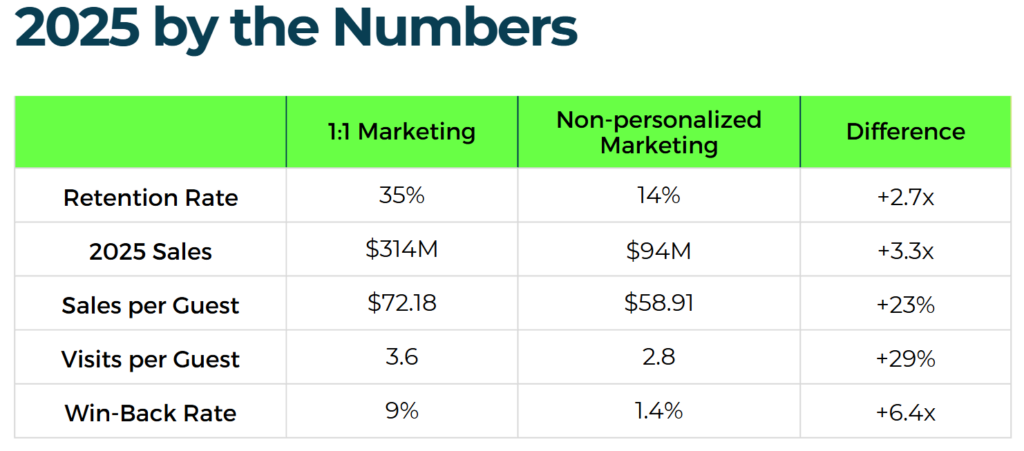
The performance gap between guests who received direct 1:1 marketing and those who did not is telling. In 2025, 1:1 outshined all other marketing approaches in every category. It drove a 2.7x higher retention rate, 23% higher sales, 29% higher visit rate per guest, and accounted for 77% of total retained sales. This difference also appears when looking at win-back efforts and new guest return rates.
Once a guest becomes inactive, the likelihood of re-engagement declines significantly. In 2025, only 1.4% of inactive guests returned to the brand without direct, personalized outreach. Inactive guests who received direct marketing returned at a 9% rate — a 636% increase!
While win-back remains possible, the data shows re-engaging guests who lapse gets more difficult the longer a guest goes without visiting. Realizing the inactive guest population continues to grow and guests don’t come back organically, it is critical for brands to identify lapsing guests and implement win-back strategies before it is too late.
DataDelivers Point of View:
“ In this environment of extreme competition for customers, brands can’t rely on guests to simply find their way back. The data shows that once a guest lapses, the odds of re-engagement drop dramatically unless marketing intervenes. A 1.4% organic return rate versus 9% with targeted outreach shows consumers are more likely to visit the brand they see in front of them. Restaurants that identify lapsing guests
early and engage are outperforming those that don’t.”
-Joel Schiltz, CEO of DataDelivers

For every new guest added in 2025, 1.4 active guests were lost. Today’s reality is that acquisition-led growth doesn’t work the way it once did. Brands are not finding enough new guests to replace what they are losing.
At the same time, the cost of acquiring new guests continues to rise. At the 2025 Restaurant Finance and Development Conference, Boston Consulting Group stated that the average cost to acquire a new restaurant customer increased from $20 in 2021 to $30 in 2025. That is 10x more expensive than the cost to retain a current guest with weekly emails.
If your average check is $30, that means a first-time guest must return at least once just to break even on acquisition spend. The problem is there are not enough guests returning for that second visit. In 2025, only 12% of new guests returned without being targeted with marketing messages. This engagement rate nearly triples to 32% when 1:1 strategies are active, underscoring how important brand awareness is with newly acquired guests. Without a clear plan to engage guests immediately after their first visit, acquisition dollars produce short-term traffic but not long-term revenue. First visits alone do not drive growth. Repeat visits do.
Brands investing in guest identification and direct engagement are winning the battle for the customer. Brands that are not investing in 1:1 marketing are falling behind further and further every year.
Brands are entering 2026 with 73% of former customers inactive; the pool of active guests continues to shrink. The fact that restaurants are starting the year with fewer active guests increases pressure on the entire operation to retain each one. Losing even a modest number of regular customers will have a larger negative impact on sales than it did in previous years.
2025 data shows that once guests stop visiting, bringing them back is difficult, especially without a direct way to reach them. As a result, preventing churn is more effective than trying to recover lost guests, and much less expensive than replacing them with new guests.
For 2026, brands that focus on identifying guests, engaging them directly, and keeping them active will find success.
Industry research highlights that restaurant leaders are increasingly prioritizing data-driven strategies to adapt to ongoing economic and demand pressures, underscoring the importance of protecting existing guest demand.
Source: James Beard Foundation, 2026 Independent Restaurant Industry Report.
DataDelivers Point of View:
“Brands pour resources into finding new customers – then watch them slip away. Acquiring customers who never come back is expensive, and this report shows it happens 88% of the time. Hoping they return isn’t a strategy; target marketing that is designed to keep your brand top of mind is. This is a serious problem, but solutions are out there. Brands just need to act now to stop the churn. ”
– Pat Riley, VP, Sales & Marketing at DataDelivers
Based on the findings in this report, restaurant leaders should prioritize the following:

If you Haven’t Already, Now is the Time to Invest in a CDP
You can’t fix what you can’t see. A Customer Data Platform connects transactions to real guest profiles, allowing you to see who is active, who is churning, and how retention is trending over time. Retention should be measured with the same discipline and visibility as sales.
Grow the Number of Existing Guests You Can Market To
Most brands can only directly reach about 20% of their guests through loyalty programs. That leaves 80% unknown and unreachable. You need to identify more guests — beyond loyalty — so you can impact more customer behaviors. The more guests you can market to, the more revenue you can generate.
Market to Them Consistently
Once guests are identified, keep your brand in front of them. Don’t wait until they disappear. Use direct, 1:1 marketing regularly to keep guests active and engaged. Retention happens when communication is ongoing — not occasional.
Discover How Much Revenue Your Guest Data Can Unlock
Every restaurant brand has untapped revenue hidden in its guest data — but most lack clear visibility into how much opportunity exists within their current guest base.
DataDelivers helps restaurant leaders quantify the revenue impact of improved guest identification, retention, and direct engagement across their portfolios.
The 2026 Restaurant Guest Engagement Report analyzes guest behavior across more than 3,200 restaurant locations, drawing on 113 million transactions and 77 million unique guests that drove over $2.7B in sales. The analysis reflects restaurant activity throughout 2025 and includes QSR, Fast Casual, and Casual Dining concepts.
Rather than relying solely on loyalty or campaign-level data, DataDelivers links transaction activity to persistent guest identifiers, enabling engagement, retention, churn, and win-back to be measured at the individual guest level over time. This approach allows restaurant leaders to understand how guests actually behave across visits and channels — not just how marketing campaigns perform in isolation.
Many brands continue to evaluate engagement primarily through loyalty programs. While valuable, loyalty data represents only a portion of the total guest base and often overstates guest engagement with a brand. By expanding analysis beyond loyalty members, this report provides a more complete and realistic view of customer behavior across the full population of guests.
Consistent methodology across multiple reporting periods allows for reliable year-over-year comparison. This continuity is critical for understanding whether engagement strategies are improving performance over time or simply masking underlying guest loss.
Current who had at least one transaction in
the analytic window (January 2023 – December 2025) For this analysis there were 77 million known guests.
o be considered inactive the guest needed to have at least one transaction in 2023 but none in 2024, these guests would be eligible for win-back in 2025.
For someone to be considered engaged with a brand they need to have at least one transaction within that calendar year. In order to be retained in 2025 a guest needed to be engaged in 2024 and engaged again in 2025.
Known guests who receive marketing directly to their devices and have purchases connected to their guest profile.
Guests who had at least one transaction with the same brand in 2024 and 2025.
A known guest who was inactive in 2024 and had a transaction in 2025.
These known guests cannot be attributed to specific marketing efforts. Since individual recipients of general advertising, Meta targeting, or no outreach at all are unknown, their engagement is categorized under the “all other marketing” guest segment.
Guests who had at least one transaction in 2024 but did not have a transaction with that same brand in 2025.
DataDelivers is the CDP built for restaurants. For more than 20 years, we have helped restaurant brands unify guest data, understand behavior, and turn insights into measurable growth.
Long before the industry adopted modern data tools, DataDelivers was connecting POS, loyalty, online ordering, and transactional systems to create a complete, actionable view of every guest. Today, our restaurant-built CDP, powered by AI insights, helps operators increase retention, drive frequency, personalize engagement, and boost sales with confidence.
Our Guest Connect solution goes beyond collecting data — it activates it. Using predictive modeling, segmentation, and 1:1 campaign execution, restaurants can identify, reach, and engage more guests directly. This empowers leaders across Marketing, IT, Finance, and Operations to make smarter decisions and measure real impact on revenue and retention.
DataDelivers is proud to support some of the most recognized restaurant brands across the U.S.